
How to Read a 5-Generation Dog Pedigree
Jeff Davis | https://perfectpedigree.com
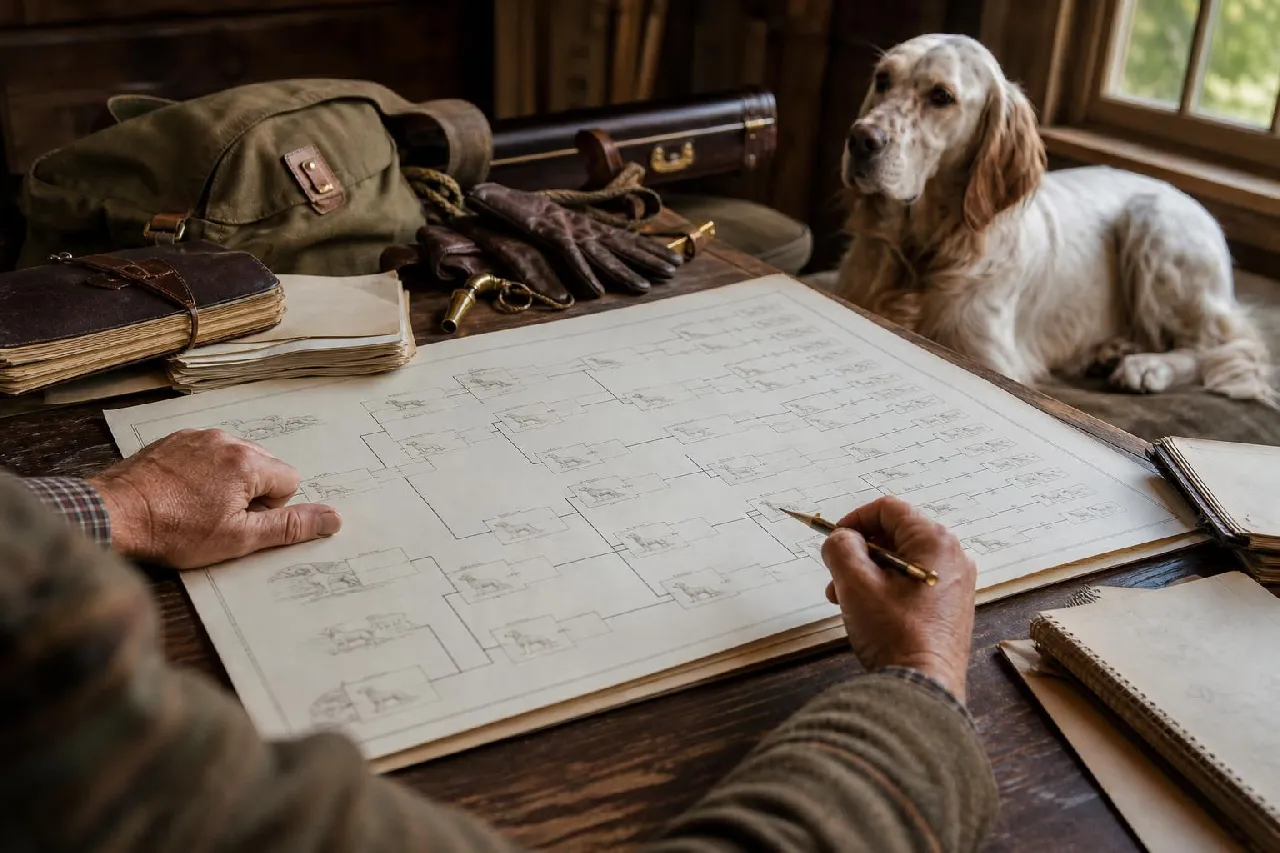
Sooner or later somebody will unfold a pedigree and slide it across the tailgate like it is a treasure map. In a way, it is. A 5-generation dog pedigree is more than a chart of sires and dams. It is a record of choices, habits, strengths, faults, and old ambitions carried forward through living blood. For anyone buying a pup, studying breeding, or simply trying to understand why one dog acts and looks the way it does, learning to read that pedigree is one of the most useful skills you can pick up.
I have always looked at pedigrees the same way I look at tracks in wet ground after first light. Anybody can see marks in the mud, but it takes a practiced eye to tell which way the game was moving, how fresh the sign is, and what likely came before it. A pedigree works much the same way. The names are there for everybody to see. The story behind them is what separates guesswork from understanding.
A 5-generation pedigree gives you a broad enough window to spot patterns without getting lost in ancient history. You can see the dog in question, its parents, grandparents, great-grandparents, and the next level beyond that. By the fifth generation, you are looking at 62 ancestors plus the dog itself, and that is enough to reveal whether a breeder has stacked certain lines, outcrossed for fresh traits, or repeated dogs that were known to stamp their offspring.
What a 5-Generation Pedigree Actually Shows
At its simplest, a pedigree is a family tree. The dog you are studying will usually appear on the left or at the top, depending on the format. From there, each generation doubles backward. The sire and dam sit closest behind the dog. Their parents come next, then their parents, and so on until you reach the fifth generation.
That structure matters because every generation tells you something different. The parents often tell you what the breeder was directly trying to produce. The grandparents begin to show consistency, or the lack of it. By the time you study the third, fourth, and fifth generations, you can often see whether certain dogs appear over and over, and that is where the pedigree starts talking plain.
Names alone do not make a pedigree valuable. A page full of registered names can impress a newcomer, but a smart buyer wants to know what those dogs were. Were they proven in the field, in the show ring, in working trials, in health testing, or only in conversation? A good pedigree is not about fancy typography. It is about evidence.
Registered Names, Kennel Names, and Titles
One of the first hurdles for beginners is understanding all the letters and prefixes. A dog may carry a kennel name at the front, a given name in the middle, and titles before or after the name. The kennel name often tells you where the dog was bred. Over time, certain kennel names become associated with a style, a purpose, or a reputation. If you notice the same kennel appearing repeatedly in a 5-generation pedigree, that can be a clue that the breeder is building from a long-established family rather than mixing unrelated stock.
Titles are where things get more interesting. Depending on the breed and registry, titles may point to conformation championships, hunting performance, obedience, field trials, protection work, or other achievements. A pedigree with proven dogs behind it often carries those titles openly, and they can help you understand the emphasis of a bloodline. If you are looking at a bird dog, for example, field titles may carry more practical weight than conformation titles if your interest is hunting ability. That does not mean one form of accomplishment is worthless. It means the pedigree should fit the purpose you have in mind.
How to Spot Linebreeding, Inbreeding, and Outcrossing
This is where a 5-generation dog pedigree starts earning its keep. When the same ancestor appears multiple times within those five generations, you are looking at linebreeding or inbreeding to one degree or another. The difference is often a matter of closeness. Tight pairings among close relatives are generally considered inbreeding, while repeating a notable dog farther back through different branches is more often called linebreeding.
Neither word should send you running by itself. Good breeders have long used linebreeding to preserve desirable traits such as nose, temperament, structure, drive, or trainability. The danger comes when people repeat blood without understanding both the strengths and the faults being concentrated. If a remarkable sire consistently threw strong hips, good minds, and natural ability, breeders may double up on him for good reason. But if he also passed weak nerves or chronic health trouble, that same concentration can come back to bite.
Outcrossing is the opposite move. It means breeding to less-related blood in hopes of bringing in vigor, diversity, or a trait missing from the current line. In a 5-generation pedigree, an outcross often stands out because there are fewer repeated names. Sometimes that is exactly what a breeding program needs. Sometimes it muddies consistency. The point is not to praise one method blindly over another. The point is to see what was done and ask whether it makes sense.
Repeated Names Are Not an Accident
When a dog shows up two, three, or four times in a 5-generation pedigree, pay attention. That usually means the breeder or earlier breeders thought that ancestor was worth anchoring the line around. Repetition can signal confidence in a dog's ability to reproduce its qualities. It can also reveal a narrow gene pool. The difference lies in the details, especially health records, temperament reports, and the performance of descendants.
A newcomer might see repeated names and think the pedigree must be stronger because it looks intentional. Sometimes it is. Other times it is simply tight breeding on average stock. That is why a pedigree should never be read in a vacuum. The paper points you where to look, but the dogs themselves provide the truth.
Reading for Purpose, Not Just Prestige
One mistake I see often is people chasing famous names without asking whether those names suit their own goals. A pedigree loaded with champions may still be the wrong pedigree for your household, hunting style, climate, or level of experience. If you want a calm family companion with predictable temperament, then nerve, trainability, and health history matter every bit as much as glamour. If you want a hard-charging hunting dog, then you need to study whether that line has actually produced dogs that do honest work in the country, not just dogs with pretty advertisements.
That is why reading a 5-generation pedigree starts with a simple question: what am I trying to get? Once you know that, the pedigree becomes easier to judge. You are not admiring a museum piece. You are weighing probabilities.
Look for consistency in the traits that matter most to you. If several generations contain working titles, proven performance dogs, or a long history of stable temperaments, that means more than one standout ancestor buried deep in the chart. A pedigree should show a pattern, not a miracle.
What a Pedigree Can Reveal About Health
A pedigree cannot diagnose a dog, but it can raise useful questions. Certain lines become known, for better or worse, for hips, eyes, cardiac issues, epilepsy, allergies, or other inherited concerns. If you are studying a 5-generation pedigree and notice the same dogs repeated often, it is worth asking what health strengths and weaknesses traveled with them.
This is where the best breeders separate themselves. They do not hide behind names on paper. They can tell you which ancestors lived long, which crosses worked, which faults showed up, and what health testing has been done. If a breeder speaks honestly about the dogs in a pedigree, good and bad alike, that usually means you are dealing with somebody who values the breed more than the sale.
Paper alone is not proof of health, but a pedigree can help you build a better set of questions. Ask about testing, longevity, causes of death, fertility, and recurring issues among littermates and close relatives. A careful pedigree reader uses the chart as a starting line, not a finish.
The Difference Between Paper Quality and Dog Quality
Old-timers have said for generations that paper does not hunt. That is true, and still, paper matters. It matters because it helps explain why a dog may have the tools it has. What it cannot do is guarantee the outcome. I have seen modest pedigrees behind excellent dogs and glittering pedigrees behind disappointments. A pedigree improves your odds when it is backed by honest breeding, sound selection, and proven stock. Without that, it is just ink.
So when you read a 5-generation dog pedigree, let it guide your judgment, not replace it. Watch the dog move. Study its temperament. Ask for health documentation. Learn about siblings and earlier litters. If possible, see parents or close relatives work. The pedigree gives context, but the living dog gives the answer.
How to Use a 5-Generation Pedigree Before Buying a Dog
If you are looking to buy a puppy or started dog, a 5-generation pedigree can help you avoid being charmed by marketing alone. Start by identifying the parents and learning what they have actually done. Then step back and scan the full five generations for repeated names, title patterns, kennel names, and any clues about the breeder's strategy. Ask why this sire was bred to this dam. Ask what previous litters from similar crosses produced. Ask what traits the breeder was trying to fix, preserve, or improve.
A serious breeder should be able to explain the pedigree in plain language. Not with sales talk, but with the kind of practical knowledge that comes from years of watching dogs mature. They should know which ancestors added grit, which added style, which softened temperaments, and which crossed especially well together. If all they can offer is that the dog is 'well bred,' keep asking.
In the end, learning how to read a 5-generation dog pedigree is about learning how to think. You are weighing inheritance, intent, and probability. You are reading history with one eye on the future. And once you get the hang of it, those names on the page stop being strangers. They become signposts pointing toward what a dog may become.
For folks interested in dog lineage and pedigrees, that is where the real value lies. A good pedigree will not make the decision for you, but it will make you a harder person to fool. And in the world of dogs, that kind of knowledge is worth carrying.
I have always looked at pedigrees the same way I look at tracks in wet ground after first light. Anybody can see marks in the mud, but it takes a practiced eye to tell which way the game was moving, how fresh the sign is, and what likely came before it. A pedigree works much the same way. The names are there for everybody to see. The story behind them is what separates guesswork from understanding.
A 5-generation pedigree gives you a broad enough window to spot patterns without getting lost in ancient history. You can see the dog in question, its parents, grandparents, great-grandparents, and the next level beyond that. By the fifth generation, you are looking at 62 ancestors plus the dog itself, and that is enough to reveal whether a breeder has stacked certain lines, outcrossed for fresh traits, or repeated dogs that were known to stamp their offspring.
What a 5-Generation Pedigree Actually Shows
At its simplest, a pedigree is a family tree. The dog you are studying will usually appear on the left or at the top, depending on the format. From there, each generation doubles backward. The sire and dam sit closest behind the dog. Their parents come next, then their parents, and so on until you reach the fifth generation.
That structure matters because every generation tells you something different. The parents often tell you what the breeder was directly trying to produce. The grandparents begin to show consistency, or the lack of it. By the time you study the third, fourth, and fifth generations, you can often see whether certain dogs appear over and over, and that is where the pedigree starts talking plain.
Names alone do not make a pedigree valuable. A page full of registered names can impress a newcomer, but a smart buyer wants to know what those dogs were. Were they proven in the field, in the show ring, in working trials, in health testing, or only in conversation? A good pedigree is not about fancy typography. It is about evidence.
Registered Names, Kennel Names, and Titles
One of the first hurdles for beginners is understanding all the letters and prefixes. A dog may carry a kennel name at the front, a given name in the middle, and titles before or after the name. The kennel name often tells you where the dog was bred. Over time, certain kennel names become associated with a style, a purpose, or a reputation. If you notice the same kennel appearing repeatedly in a 5-generation pedigree, that can be a clue that the breeder is building from a long-established family rather than mixing unrelated stock.
Titles are where things get more interesting. Depending on the breed and registry, titles may point to conformation championships, hunting performance, obedience, field trials, protection work, or other achievements. A pedigree with proven dogs behind it often carries those titles openly, and they can help you understand the emphasis of a bloodline. If you are looking at a bird dog, for example, field titles may carry more practical weight than conformation titles if your interest is hunting ability. That does not mean one form of accomplishment is worthless. It means the pedigree should fit the purpose you have in mind.
How to Spot Linebreeding, Inbreeding, and Outcrossing
This is where a 5-generation dog pedigree starts earning its keep. When the same ancestor appears multiple times within those five generations, you are looking at linebreeding or inbreeding to one degree or another. The difference is often a matter of closeness. Tight pairings among close relatives are generally considered inbreeding, while repeating a notable dog farther back through different branches is more often called linebreeding.
Neither word should send you running by itself. Good breeders have long used linebreeding to preserve desirable traits such as nose, temperament, structure, drive, or trainability. The danger comes when people repeat blood without understanding both the strengths and the faults being concentrated. If a remarkable sire consistently threw strong hips, good minds, and natural ability, breeders may double up on him for good reason. But if he also passed weak nerves or chronic health trouble, that same concentration can come back to bite.
Outcrossing is the opposite move. It means breeding to less-related blood in hopes of bringing in vigor, diversity, or a trait missing from the current line. In a 5-generation pedigree, an outcross often stands out because there are fewer repeated names. Sometimes that is exactly what a breeding program needs. Sometimes it muddies consistency. The point is not to praise one method blindly over another. The point is to see what was done and ask whether it makes sense.
Repeated Names Are Not an Accident
When a dog shows up two, three, or four times in a 5-generation pedigree, pay attention. That usually means the breeder or earlier breeders thought that ancestor was worth anchoring the line around. Repetition can signal confidence in a dog's ability to reproduce its qualities. It can also reveal a narrow gene pool. The difference lies in the details, especially health records, temperament reports, and the performance of descendants.
A newcomer might see repeated names and think the pedigree must be stronger because it looks intentional. Sometimes it is. Other times it is simply tight breeding on average stock. That is why a pedigree should never be read in a vacuum. The paper points you where to look, but the dogs themselves provide the truth.
Reading for Purpose, Not Just Prestige
One mistake I see often is people chasing famous names without asking whether those names suit their own goals. A pedigree loaded with champions may still be the wrong pedigree for your household, hunting style, climate, or level of experience. If you want a calm family companion with predictable temperament, then nerve, trainability, and health history matter every bit as much as glamour. If you want a hard-charging hunting dog, then you need to study whether that line has actually produced dogs that do honest work in the country, not just dogs with pretty advertisements.
That is why reading a 5-generation pedigree starts with a simple question: what am I trying to get? Once you know that, the pedigree becomes easier to judge. You are not admiring a museum piece. You are weighing probabilities.
Look for consistency in the traits that matter most to you. If several generations contain working titles, proven performance dogs, or a long history of stable temperaments, that means more than one standout ancestor buried deep in the chart. A pedigree should show a pattern, not a miracle.
What a Pedigree Can Reveal About Health
A pedigree cannot diagnose a dog, but it can raise useful questions. Certain lines become known, for better or worse, for hips, eyes, cardiac issues, epilepsy, allergies, or other inherited concerns. If you are studying a 5-generation pedigree and notice the same dogs repeated often, it is worth asking what health strengths and weaknesses traveled with them.
This is where the best breeders separate themselves. They do not hide behind names on paper. They can tell you which ancestors lived long, which crosses worked, which faults showed up, and what health testing has been done. If a breeder speaks honestly about the dogs in a pedigree, good and bad alike, that usually means you are dealing with somebody who values the breed more than the sale.
Paper alone is not proof of health, but a pedigree can help you build a better set of questions. Ask about testing, longevity, causes of death, fertility, and recurring issues among littermates and close relatives. A careful pedigree reader uses the chart as a starting line, not a finish.
The Difference Between Paper Quality and Dog Quality
Old-timers have said for generations that paper does not hunt. That is true, and still, paper matters. It matters because it helps explain why a dog may have the tools it has. What it cannot do is guarantee the outcome. I have seen modest pedigrees behind excellent dogs and glittering pedigrees behind disappointments. A pedigree improves your odds when it is backed by honest breeding, sound selection, and proven stock. Without that, it is just ink.
So when you read a 5-generation dog pedigree, let it guide your judgment, not replace it. Watch the dog move. Study its temperament. Ask for health documentation. Learn about siblings and earlier litters. If possible, see parents or close relatives work. The pedigree gives context, but the living dog gives the answer.
How to Use a 5-Generation Pedigree Before Buying a Dog
If you are looking to buy a puppy or started dog, a 5-generation pedigree can help you avoid being charmed by marketing alone. Start by identifying the parents and learning what they have actually done. Then step back and scan the full five generations for repeated names, title patterns, kennel names, and any clues about the breeder's strategy. Ask why this sire was bred to this dam. Ask what previous litters from similar crosses produced. Ask what traits the breeder was trying to fix, preserve, or improve.
A serious breeder should be able to explain the pedigree in plain language. Not with sales talk, but with the kind of practical knowledge that comes from years of watching dogs mature. They should know which ancestors added grit, which added style, which softened temperaments, and which crossed especially well together. If all they can offer is that the dog is 'well bred,' keep asking.
In the end, learning how to read a 5-generation dog pedigree is about learning how to think. You are weighing inheritance, intent, and probability. You are reading history with one eye on the future. And once you get the hang of it, those names on the page stop being strangers. They become signposts pointing toward what a dog may become.
For folks interested in dog lineage and pedigrees, that is where the real value lies. A good pedigree will not make the decision for you, but it will make you a harder person to fool. And in the world of dogs, that kind of knowledge is worth carrying.


View all 0 comments