Linebreeding vs Inbreeding vs Outcrossing (Explained Simply)
Why the Terms Matter
Jeff Davis | https://perfectpedigree.com
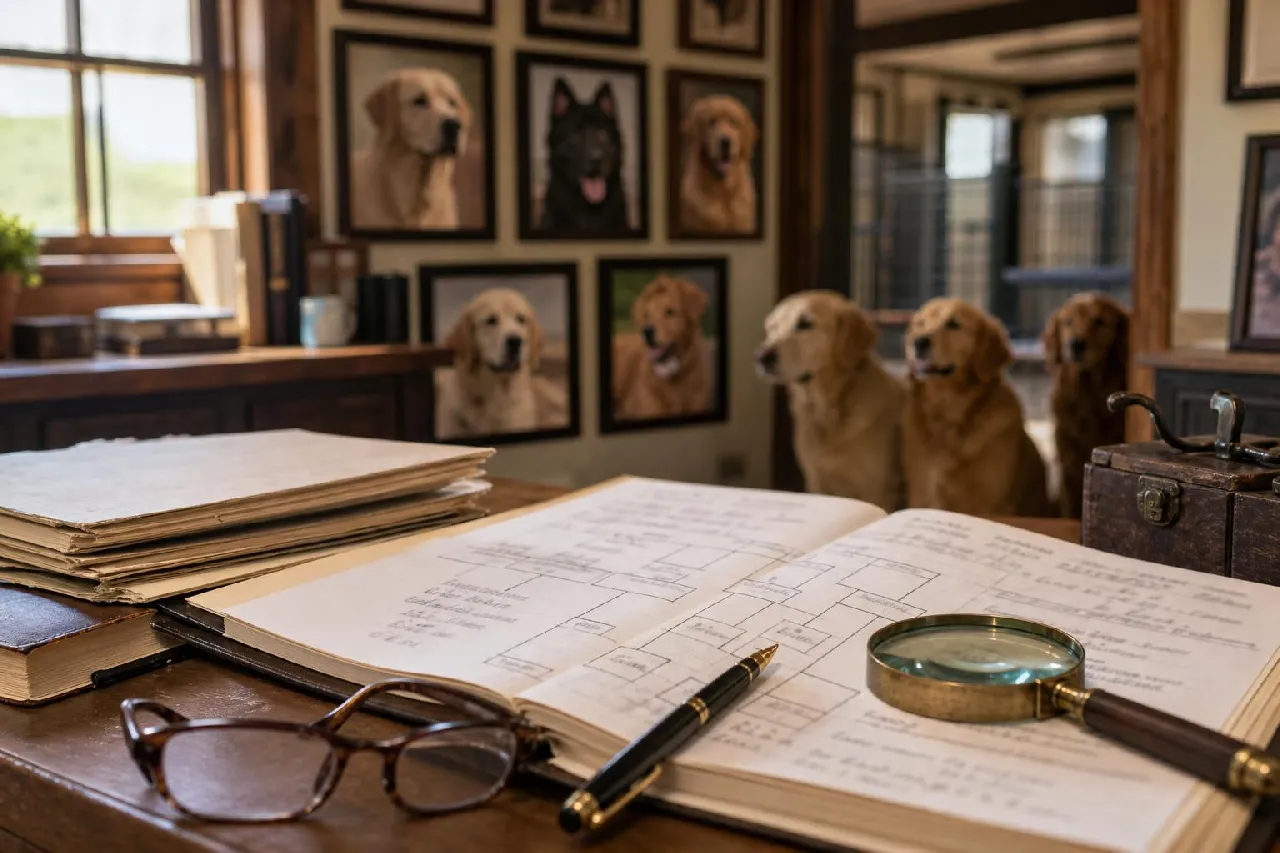
Spend enough time around breeders, hunters, and pedigree men, and you will hear the same three words come up again and again: linebreeding, inbreeding, and outcrossing. Folks use them like everybody ought to know exactly what they mean. Truth is, many good dog people only have a rough idea. They know one cross is considered tight, another loose, and another fresh, but they cannot always explain where one ends and the next begins.
If you are looking to buy a puppy, study working dog bloodlines, or simply understand how certain traits keep showing up generation after generation, these breeding methods matter. They influence how predictable a litter may be, how strongly certain qualities are stamped, and how much risk may come along for the ride. A pedigree is not just a family tree on paper. It is a trail map showing where the dog came from, what was repeated, and what was introduced from outside.
I have spent enough time looking over old pedigrees to know that the names repeated in a pedigree are rarely there by accident. Whether we are talking bird dogs, hounds, retrievers, or any other purpose-bred dog, breeders have long used these methods to shape what they wanted in the kennel. Some did it well with a sharp eye and hard standards. Others chased papers more than dogs and paid for it later.
What Is Inbreeding in Dogs?
Inbreeding is the closest form of breeding between related dogs. In plain terms, it means pairing dogs that are very near kin, such as father to daughter, mother to son, or brother to sister. It is the most concentrated way to lock in genes from a particular family.
The reason breeders use inbreeding is simple enough. If a line carries a strong set of desirable traits, close breeding can make those traits show up with greater consistency. If a stud throws excellent noses, sound structure, and steady temperament, a breeder might be tempted to tighten the family around him to preserve exactly what made him special.
But close breeding does not only fix the good. It can fix the faults too, and sometimes faster than a man expects. Weak nerves, bad hips, poor bites, skin trouble, fertility problems, or plain lack of working sense may also become more visible. Inbreeding increases homozygosity, which is a technical way of saying the puppies are more likely to inherit the same version of a gene from both sides. That is why the strengths can become more reliable, but it is also why hidden defects can come roaring to the surface.
Old-time breeders sometimes used inbreeding as a test. If a family was truly strong, close breeding would reveal it. If there were cracks in the foundation, they showed up too. That sounds harsh to modern ears, but from a breeding standpoint, it was a way of finding out what a line really carried. Still, it takes uncommon honesty and a willingness to cull breeding stock from the program when faults appear. Without that discipline, inbreeding can do lasting damage in a hurry.
When buyers should pay attention to inbreeding
If you see very close relatives paired in a pedigree, do not panic, but do ask questions. You want to know why the breeder made that decision, what health testing was done, and what came out of similar crosses before. A breeder who understands the pedigree can tell you exactly what he was trying to preserve and what risks he had in mind. A breeder who gets defensive or vague may be telling you more than he realizes.
What Is Linebreeding in Dogs?
Linebreeding is a milder and more commonly accepted form of breeding within a family. The dogs are still related, but not as closely as with direct inbreeding. Think of pairings like grandfather to granddaughter, uncle to niece, half-brother to half-sister, or breeding two dogs that both descend from the same outstanding ancestor a few generations back.
If inbreeding is a tight circle, linebreeding is a wider loop around the same fire. The goal is still to preserve the traits of a specific family or a certain influential dog, but with a little more breathing room. Good breeders often linebreed because it gives them a balance between consistency and flexibility. They can reinforce hunting instinct, conformation, trainability, coat type, or temperament without taking as much risk as the tightest crosses.
This is where pedigrees get interesting. You may look at a five-generation pedigree and see one famous name appear three, four, or five times. That usually means the breeder is building around that dog's influence. He may not be breeding close enough to be called inbreeding, but he is certainly trying to stack the deck in favor of a known type.
In practical terms, linebreeding is often used to make litters more predictable. A well-linebred litter may not produce carbon copies, but the pups are often more uniform in type, drive, and style than a totally mixed pedigree. For buyers, that matters. Predictability is one of the chief values of a good pedigree. If you are buying a gun dog, you want a fair idea of what you are raising before the pup is old enough to chase its first bird.
Why linebreeding is often misunderstood
Many people hear that a pedigree is linebred and assume that means something is wrong. Not necessarily. Much depends on how tightly the breeding was done, how healthy the family is, and whether the breeder has selected hard for quality over time. A smart linebreeding program can preserve the best parts of a family while avoiding the worst traps of close inbreeding. A careless one can still compound faults. The paper alone never tells the whole story. You have to know the dogs behind the names.
What Is Outcrossing in Dogs?
Outcrossing means breeding two dogs that are not closely related, usually within the same breed but from distinctly different families. This is done to bring in fresh genetic material, improve vigor, and sometimes correct weaknesses that have become too common in a line.
Say a kennel has produced strong dogs for years, but over time they have become too soft in temperament, too small in frame, or too prone to a certain health issue. An outcross may be used to introduce traits that are missing or fading. It is a way to open the windows in the breeding house and let some new air blow through.
Now, that fresh air comes with a price. Outcrossing often reduces predictability in the first generation. You may get excellent results, but you may also get a wider spread of traits. One pup may favor one side heavily, another may split the difference, and another may not fit the breeder's goal at all. That does not make outcrossing bad. It just means it can be less uniform, especially when the two families differ in important ways.
The best outcrosses are not random. Good breeders do not simply breed to an unrelated dog because the pedigree looks different. They choose an outcross that still fits the purpose of the line. In the hunting world, that means the outside dog should still have the kind of nose, stamina, cooperation, structure, and brains that the breeder values. Otherwise, the outcross may solve one problem while creating two more.
What outcrossing can accomplish
When done right, outcrossing can restore vigor, improve health, and add useful traits that a line has lost. It can also create the foundation for a stronger family in future generations. Many respected breeding programs were built by making a careful outcross and then linebreeding the best offspring that came from it. In that way, outcrossing and linebreeding often work hand in hand rather than standing as opposites.
The Simple Difference Between the Three
If you want the plainest explanation, here it is. Inbreeding is very close family breeding. Linebreeding is moderate family breeding built around a shared ancestor. Outcrossing is breeding to an unrelated or more distantly related dog to bring in new blood. All three methods are tools. None is automatically wise or foolish on its own. The outcome depends on the quality of the dogs, the honesty of the breeder, and the purpose behind the cross.
A shotgun in good hands can fill a game bag. In careless hands, it only makes noise. Breeding is much the same. The method matters, but the judgment behind it matters more.
What Pedigree Buyers Should Look For
If you are buying a puppy and studying pedigrees, do not get hypnotized by famous names alone. Look for patterns. Are certain dogs repeated heavily? Are there health-tested ancestors? Do the dogs in the pedigree have proven work, sound structure, and stable temperament? Has the breeder used these bloodlines long enough to know what they produce?
Ask what the cross was meant to achieve. A serious breeder should be able to explain that in plain language. Maybe he linebred to hold onto a certain style in the field. Maybe he made an outcross to improve genetic diversity or strengthen structure. Maybe a close breeding was done because the family had already proven itself over generations. Whatever the case, there ought to be a reason beyond convenience or pedigree fashion.
It also helps to remember that papers do not raise pups. The living dogs in front of you matter more than the ink behind them. Watch how the parents carry themselves. Pay attention to nerves, energy, soundness, and disposition. A fine-looking pedigree paired with poor real-world dogs is a hollow thing.
Final Thoughts on Linebreeding, Inbreeding, and Outcrossing
The old breeders who built great families of dogs understood one truth that still holds today: breeding is the slow art of stacking odds. You are never guaranteed perfection. What you can do is improve your chances by understanding the blood, knowing the dogs, and making decisions with your eyes open.
Linebreeding, inbreeding, and outcrossing are not mysterious once you strip away the jargon. They are simply different ways of managing ancestry. Inbreeding tightens the family hard. Linebreeding keeps the family influence while leaving more room. Outcrossing brings in new blood to refresh or improve what is already there. For anyone interested in dog lineage and pedigrees, learning these terms is one of the best first steps toward reading a pedigree with confidence.
And when you can read a pedigree with confidence, you are no longer just looking at names on paper. You are seeing the breeder's hand, the history of the line, and the chances of what that pup may become.
If you are looking to buy a puppy, study working dog bloodlines, or simply understand how certain traits keep showing up generation after generation, these breeding methods matter. They influence how predictable a litter may be, how strongly certain qualities are stamped, and how much risk may come along for the ride. A pedigree is not just a family tree on paper. It is a trail map showing where the dog came from, what was repeated, and what was introduced from outside.
I have spent enough time looking over old pedigrees to know that the names repeated in a pedigree are rarely there by accident. Whether we are talking bird dogs, hounds, retrievers, or any other purpose-bred dog, breeders have long used these methods to shape what they wanted in the kennel. Some did it well with a sharp eye and hard standards. Others chased papers more than dogs and paid for it later.
What Is Inbreeding in Dogs?
Inbreeding is the closest form of breeding between related dogs. In plain terms, it means pairing dogs that are very near kin, such as father to daughter, mother to son, or brother to sister. It is the most concentrated way to lock in genes from a particular family.
The reason breeders use inbreeding is simple enough. If a line carries a strong set of desirable traits, close breeding can make those traits show up with greater consistency. If a stud throws excellent noses, sound structure, and steady temperament, a breeder might be tempted to tighten the family around him to preserve exactly what made him special.
But close breeding does not only fix the good. It can fix the faults too, and sometimes faster than a man expects. Weak nerves, bad hips, poor bites, skin trouble, fertility problems, or plain lack of working sense may also become more visible. Inbreeding increases homozygosity, which is a technical way of saying the puppies are more likely to inherit the same version of a gene from both sides. That is why the strengths can become more reliable, but it is also why hidden defects can come roaring to the surface.
Old-time breeders sometimes used inbreeding as a test. If a family was truly strong, close breeding would reveal it. If there were cracks in the foundation, they showed up too. That sounds harsh to modern ears, but from a breeding standpoint, it was a way of finding out what a line really carried. Still, it takes uncommon honesty and a willingness to cull breeding stock from the program when faults appear. Without that discipline, inbreeding can do lasting damage in a hurry.
When buyers should pay attention to inbreeding
If you see very close relatives paired in a pedigree, do not panic, but do ask questions. You want to know why the breeder made that decision, what health testing was done, and what came out of similar crosses before. A breeder who understands the pedigree can tell you exactly what he was trying to preserve and what risks he had in mind. A breeder who gets defensive or vague may be telling you more than he realizes.
What Is Linebreeding in Dogs?
Linebreeding is a milder and more commonly accepted form of breeding within a family. The dogs are still related, but not as closely as with direct inbreeding. Think of pairings like grandfather to granddaughter, uncle to niece, half-brother to half-sister, or breeding two dogs that both descend from the same outstanding ancestor a few generations back.
If inbreeding is a tight circle, linebreeding is a wider loop around the same fire. The goal is still to preserve the traits of a specific family or a certain influential dog, but with a little more breathing room. Good breeders often linebreed because it gives them a balance between consistency and flexibility. They can reinforce hunting instinct, conformation, trainability, coat type, or temperament without taking as much risk as the tightest crosses.
This is where pedigrees get interesting. You may look at a five-generation pedigree and see one famous name appear three, four, or five times. That usually means the breeder is building around that dog's influence. He may not be breeding close enough to be called inbreeding, but he is certainly trying to stack the deck in favor of a known type.
In practical terms, linebreeding is often used to make litters more predictable. A well-linebred litter may not produce carbon copies, but the pups are often more uniform in type, drive, and style than a totally mixed pedigree. For buyers, that matters. Predictability is one of the chief values of a good pedigree. If you are buying a gun dog, you want a fair idea of what you are raising before the pup is old enough to chase its first bird.
Why linebreeding is often misunderstood
Many people hear that a pedigree is linebred and assume that means something is wrong. Not necessarily. Much depends on how tightly the breeding was done, how healthy the family is, and whether the breeder has selected hard for quality over time. A smart linebreeding program can preserve the best parts of a family while avoiding the worst traps of close inbreeding. A careless one can still compound faults. The paper alone never tells the whole story. You have to know the dogs behind the names.
What Is Outcrossing in Dogs?
Outcrossing means breeding two dogs that are not closely related, usually within the same breed but from distinctly different families. This is done to bring in fresh genetic material, improve vigor, and sometimes correct weaknesses that have become too common in a line.
Say a kennel has produced strong dogs for years, but over time they have become too soft in temperament, too small in frame, or too prone to a certain health issue. An outcross may be used to introduce traits that are missing or fading. It is a way to open the windows in the breeding house and let some new air blow through.
Now, that fresh air comes with a price. Outcrossing often reduces predictability in the first generation. You may get excellent results, but you may also get a wider spread of traits. One pup may favor one side heavily, another may split the difference, and another may not fit the breeder's goal at all. That does not make outcrossing bad. It just means it can be less uniform, especially when the two families differ in important ways.
The best outcrosses are not random. Good breeders do not simply breed to an unrelated dog because the pedigree looks different. They choose an outcross that still fits the purpose of the line. In the hunting world, that means the outside dog should still have the kind of nose, stamina, cooperation, structure, and brains that the breeder values. Otherwise, the outcross may solve one problem while creating two more.
What outcrossing can accomplish
When done right, outcrossing can restore vigor, improve health, and add useful traits that a line has lost. It can also create the foundation for a stronger family in future generations. Many respected breeding programs were built by making a careful outcross and then linebreeding the best offspring that came from it. In that way, outcrossing and linebreeding often work hand in hand rather than standing as opposites.
The Simple Difference Between the Three
If you want the plainest explanation, here it is. Inbreeding is very close family breeding. Linebreeding is moderate family breeding built around a shared ancestor. Outcrossing is breeding to an unrelated or more distantly related dog to bring in new blood. All three methods are tools. None is automatically wise or foolish on its own. The outcome depends on the quality of the dogs, the honesty of the breeder, and the purpose behind the cross.
A shotgun in good hands can fill a game bag. In careless hands, it only makes noise. Breeding is much the same. The method matters, but the judgment behind it matters more.
What Pedigree Buyers Should Look For
If you are buying a puppy and studying pedigrees, do not get hypnotized by famous names alone. Look for patterns. Are certain dogs repeated heavily? Are there health-tested ancestors? Do the dogs in the pedigree have proven work, sound structure, and stable temperament? Has the breeder used these bloodlines long enough to know what they produce?
Ask what the cross was meant to achieve. A serious breeder should be able to explain that in plain language. Maybe he linebred to hold onto a certain style in the field. Maybe he made an outcross to improve genetic diversity or strengthen structure. Maybe a close breeding was done because the family had already proven itself over generations. Whatever the case, there ought to be a reason beyond convenience or pedigree fashion.
It also helps to remember that papers do not raise pups. The living dogs in front of you matter more than the ink behind them. Watch how the parents carry themselves. Pay attention to nerves, energy, soundness, and disposition. A fine-looking pedigree paired with poor real-world dogs is a hollow thing.
Final Thoughts on Linebreeding, Inbreeding, and Outcrossing
The old breeders who built great families of dogs understood one truth that still holds today: breeding is the slow art of stacking odds. You are never guaranteed perfection. What you can do is improve your chances by understanding the blood, knowing the dogs, and making decisions with your eyes open.
Linebreeding, inbreeding, and outcrossing are not mysterious once you strip away the jargon. They are simply different ways of managing ancestry. Inbreeding tightens the family hard. Linebreeding keeps the family influence while leaving more room. Outcrossing brings in new blood to refresh or improve what is already there. For anyone interested in dog lineage and pedigrees, learning these terms is one of the best first steps toward reading a pedigree with confidence.
And when you can read a pedigree with confidence, you are no longer just looking at names on paper. You are seeing the breeder's hand, the history of the line, and the chances of what that pup may become.


View all 0 comments