
Duck Hunting
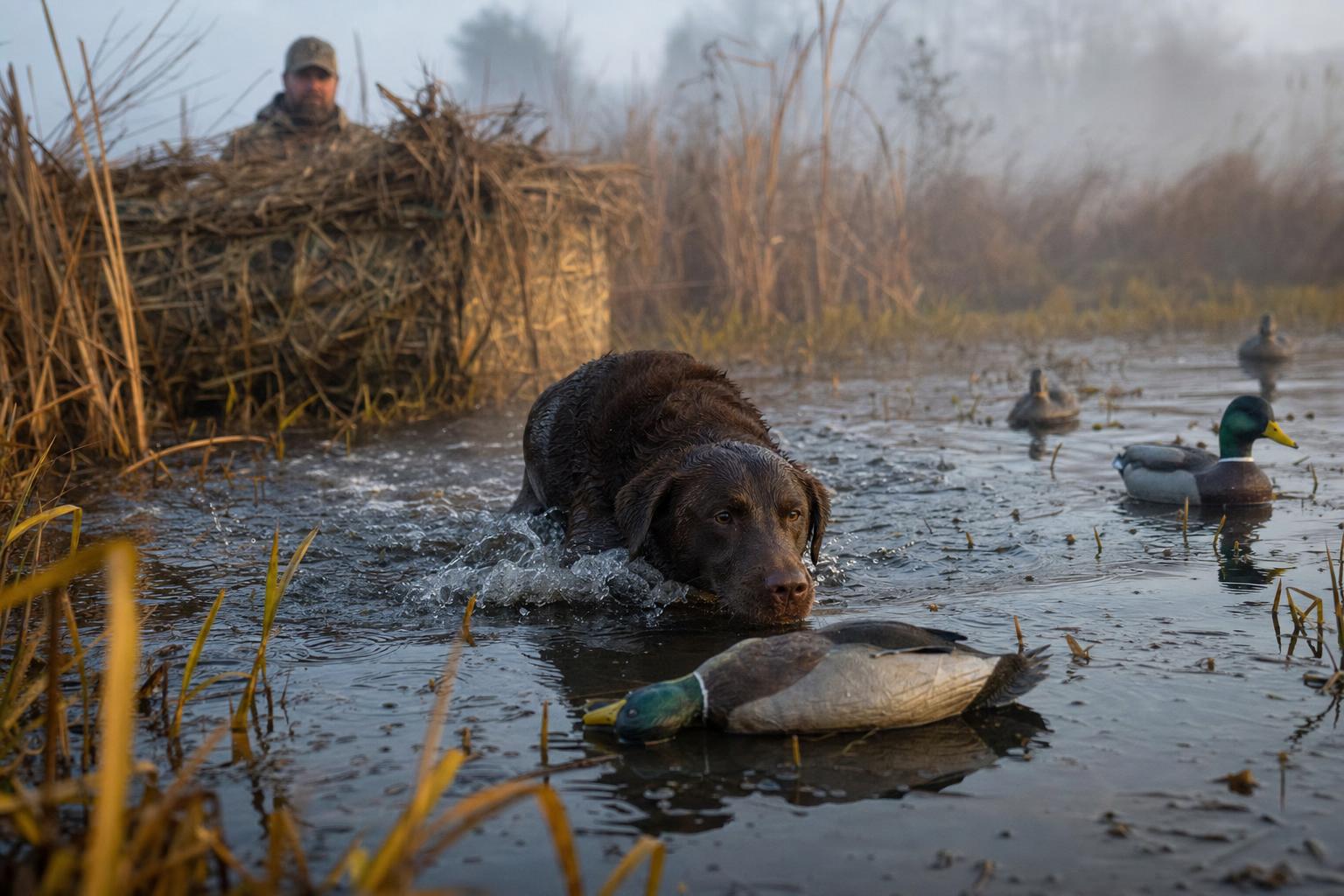
Duck hunting with dogs is built around one central problem: birds fall into water and cover where humans can’t reliably recover them without help. A good dog turns that problem into a repeatable system. In marshes, flooded timber, rivers, rice fields, and open water, the dog’s role is to remain steady in a blind, mark falling birds, take clean lines through water and cover, and deliver birds gently to hand. The best dogs do this while ignoring gunfire, decoys, other hunters, boats, and cold water. It’s not just retrieving; it’s composure under stimulus. A duck dog has to be able to do nothing for long stretches, then switch to immediate action when a bird drops.
Training usually starts with basic retrieving desire and then adds structure. The dog learns hold and delivery so birds are carried gently. It learns steadiness so it doesn’t launch before being sent. It learns to sit quietly in a blind, on a platform, or in a boat without whining, creeping, or breaking. Marking is a major skill: watching where a bird falls, remembering it, and driving directly to that spot even when the handler can’t see the landing. Then you layer in handling. A dog can’t always see a downed bird—night hunts, heavy cover, long distances, or multiple birds down at once—so the dog learns to take casts and whistles: stop on a whistle, take a left or right back cast, and run a line on cue. These are the skills that turn a dog from “enthusiastic retriever” into a controlled waterfowl partner.
The environment adds serious difficulty. Cold water taxes a dog’s body, and wind and current change everything about how a retrieve feels. Ice can cut paws and legs. Thick vegetation can hide a bird a few feet away. Strong scent from the marsh can distract a young dog. That’s why conditioning and safety habits matter: gradual exposure to cold, safe entry and exit from boats, monitoring for hypothermia, proper rest, and careful use of equipment like neoprene vests when appropriate. A good dog also learns how to push through reeds and lily pads without getting tangled or frustrated. And because waterfowl hunting can involve multiple birds down, the dog learns memory and composure—take one bird, deliver, then be sent for the next without melting down.
What makes duck hunting with dogs so satisfying is the blend of calm and action. A well-trained dog sits quietly while shots ring out, eyes locked on the sky. When the handler sends, the dog explodes into motion, takes a straight line, locates the bird, and returns cleanly. That reliability makes hunts safer and more ethical because it reduces lost birds and allows hunters to focus on shot selection and safe angles rather than scrambling through marsh. It also creates a unique bond. The dog is not a spectator; it is a working partner whose skills determine how successful the day will be. When a dog handles a tough mark in wind or takes a long blind retrieve through cover, you’re watching training, genetics, and teamwork combine into something very practical and very impressive.