
Dove Hunting
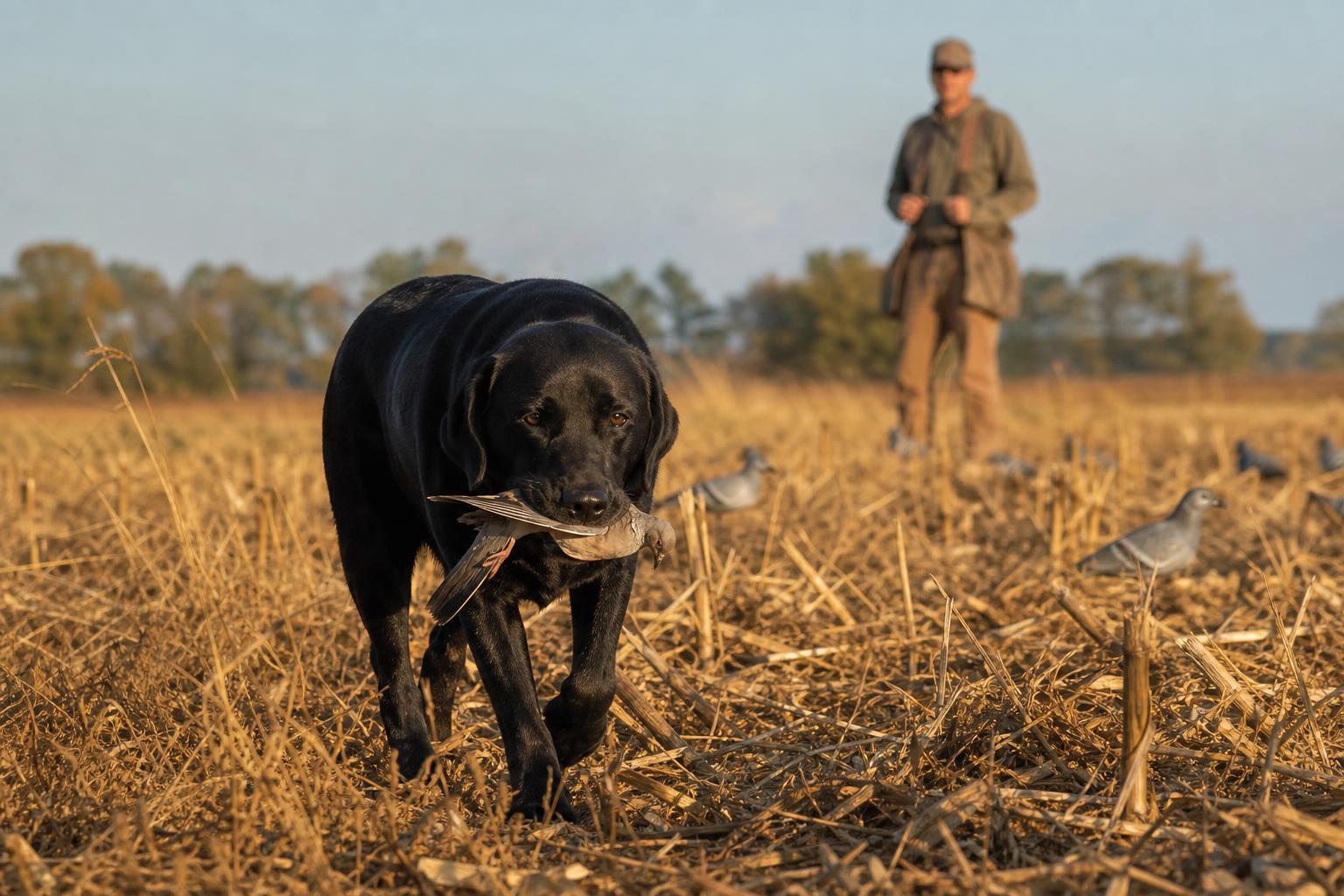
Dove hunting with dogs is often thought of as a stand-and-shoot tradition—fields, decoys, fast passing birds—but a good dog can turn it into a cleaner, more efficient, and more ethical experience. Doves are small, can fall far from where they’re hit, and can be surprisingly difficult to find in stubble, grass, or weedy edges. A dog that marks falls well and retrieves reliably prevents wasted birds and keeps the field safer because hunters aren’t wandering around with loaded guns searching for downed game. The dog’s job is simple in concept: stay steady during shooting, watch where birds fall, and recover them quickly and gently. But that “steady during shooting” part is exactly where training shows.
Training focuses on calm under high stimulation. In a busy dove field, shots can be constant, other dogs and hunters may be nearby, and birds can fall in multiple directions in quick succession. A solid dog learns to remain in place until sent. It learns to ignore birds that are wounded and flapping unless the handler directs a retrieve. It learns to watch the sky and then lock onto the fall—marking—so it can take a straight line to the bird. Because doves are delicate, soft mouth is important, and clean delivery to hand makes the process quick. Many teams also teach the dog to remain quiet, because barking and whining in a dove field is distracting and can disrupt safety.
The environment is its own challenge. Dove fields can be hot and dry early in the season, and dogs can overheat quickly if not managed. Footing may be sharp—stubble, shells, debris—and dogs may need water access and rest. Wind can drift birds far after they’re hit, making marks more difficult. In fields with tree lines, birds can fall into thick cover, where scent is stronger but visibility is lower. A dog that can switch from “mark and run straight” to “hunt carefully in cover” is valuable. Many handlers also teach simple handling cues for situations where the dog didn’t see a fall or needs to be guided away from other hunters’ birds.
What a good dog adds to dove hunting is smoothness. The hunt becomes less about scrambling and more about controlled shooting and quick recovery. The dog becomes a safety asset: hunters stay in their positions, guns stay pointed safely, and retrieves happen on purpose. For the dog, it can be a fun, rewarding job because the pattern is clear—wait, watch, retrieve, deliver, repeat—without the complex running and holding games of other bird styles. When the dog is trained well and managed thoughtfully in heat and crowd conditions, dove hunting with a dog becomes one of the most straightforward examples of why working dogs matter: they recover what humans would miss and they do it in a way that respects the game.