
Personal Protection
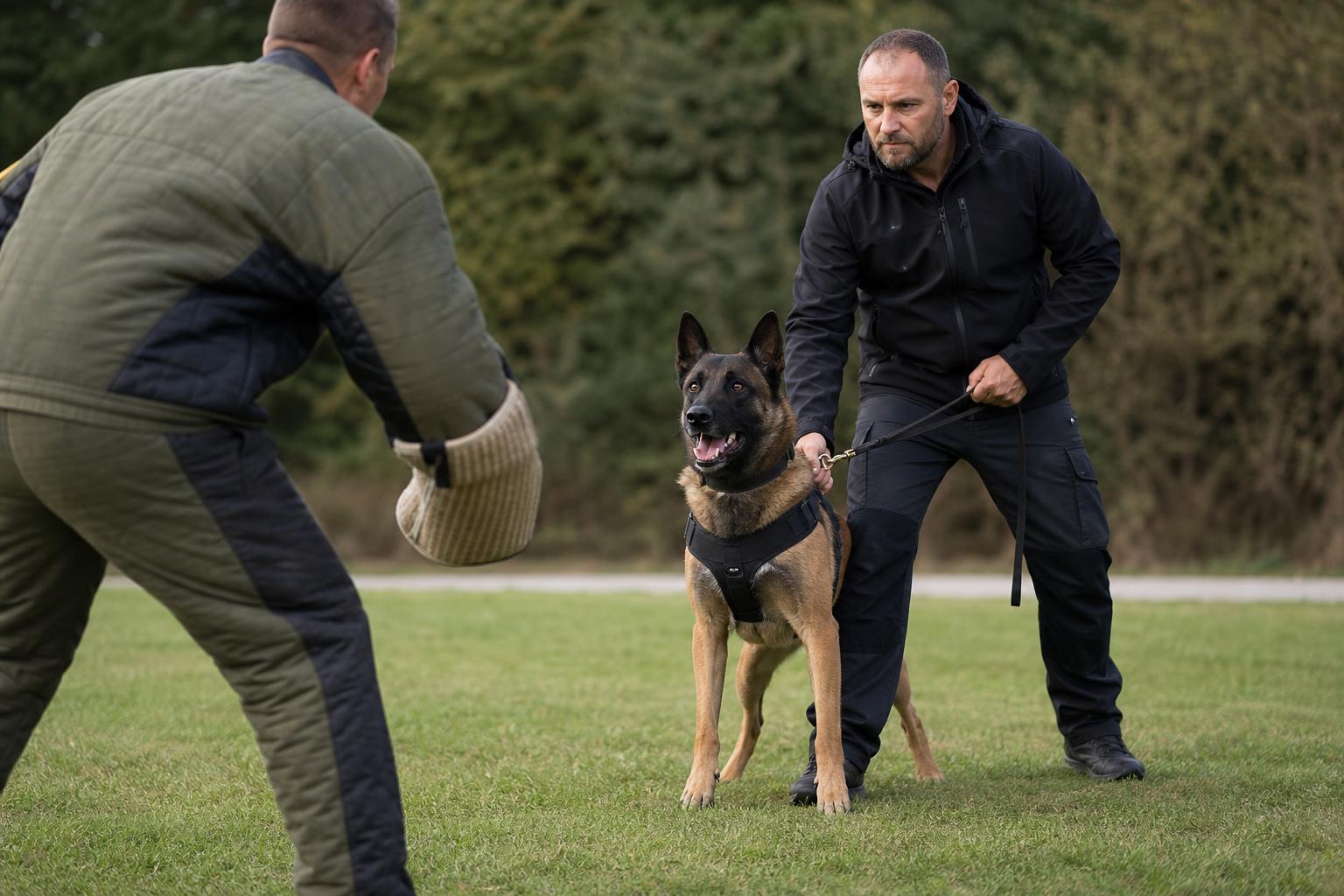
Personal protection training is the process of teaching a dog to help deter, interrupt, or respond to threatening behavior while remaining safe and controllable. The words sound dramatic, but the most important features are not drama at all. They are stability, judgment, and control. A dog that cannot be reliably called off, or a dog that is nervous and reactive, is not a candidate for this work. The ideal dog is calm in normal life, neutral around people, confident in unfamiliar environments, and able to follow the handler’s direction under stress. The goal is a dog that adds a layer of safety, not a dog that creates new risk.
Good programs start with temperament and obedience. The dog learns to heel, stay, recall, and disengage from temptations. The dog learns boundary behaviors: settle on a mat, remain quiet, ignore people unless invited. Then the dog learns clear cues for specific actions. Trainers often build targeting skills, barking on cue, and controlled engagement patterns with a decoy, but always with a strong emphasis on outs and recalls. The dog must understand when the work starts and when it stops. The handler must be able to stop the dog instantly, even when the dog is highly aroused. That is not optional. It is the safety line. Training also includes environmental proofing: slick floors, stairs, doorways, vehicles, darkness, loud noise. A dog that can only perform in a quiet training field is not prepared.
Another major part is discrimination. The dog should not treat every stranger as a threat. The dog should not be taught to be suspicious by default. Instead, the dog is taught to respond to specific pictures: a threat posture, an approach pattern, an assault on the handler, an invasion of space after clear warnings. Even then, the dog’s response is trained with boundaries. Many systems teach a progression: alert and bark, create distance, hold and guard, engage only if the threat continues. Responsible trainers also teach the handler how to avoid bad situations, how to read their dog’s stress signals, and how to manage the dog in public. They treat this like a serious tool, not a toy.
It is also worth saying plainly: personal protection is not a substitute for good security habits, lighting, cameras, locks, or awareness. A dog is a living animal with emotions and limitations. Training is only ethical if the dog is suited for it, enjoys the work, and is kept safe physically and mentally. When done well, the outcome is not a “mean dog.” It is a dog that is steady, clear, and responsive—an animal that can stand between you and trouble if it must, and then walk away with you calmly when the situation ends. That calm switch—power on, power off—is the true marker of quality.