Patrol Dog
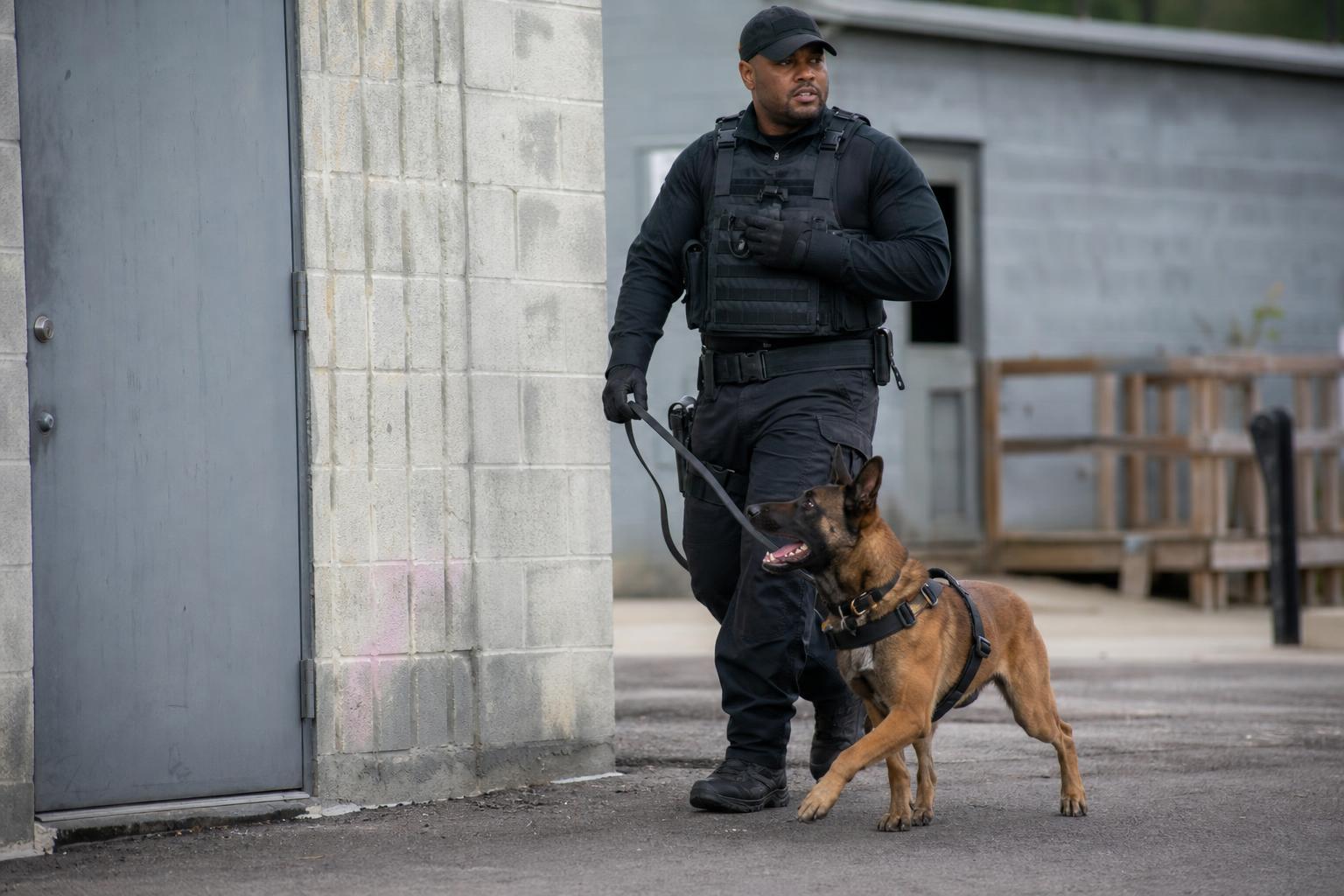
A patrol dog is trained to operate with a handler in situations that may include searching, suspect apprehension, controlled engagement, and rapid transitions between high arousal and strict obedience. In law-enforcement and security contexts, the work is designed around risk management: the dog is a tool for locating, deterring, and stopping threats, but only under clear direction. This is not simply “bite work.” It’s a broad skill set that includes environmental confidence, strong nerve, athletic conditioning, scent-based searching, and the ability to disengage instantly. The dog must be safe, stable, and predictable even when the environment is loud, chaotic, and unfamiliar.
Training starts with foundational control and engagement. The dog learns to work for the handler, to stay focused around distractions, and to perform obedience behaviors with speed and clarity. A dog that is slow to respond, conflicted about commands, or easily distracted becomes dangerous when stress rises. From there, teams develop search behaviors—building patterns for scanning areas, checking vehicles, working buildings, and indicating human presence or evidence depending on the program. A lot of this looks like structured games at first, because you build desire to hunt and confidence to enter dark rooms, climb stairs, cross slick floors, and push through narrow spaces.
Controlled engagement work, when included, is trained with strict criteria. The dog learns when to engage, how to maintain control in contact, and how to release immediately. The out is trained as a primary skill, not an afterthought. The recall off a moving target is trained as a life-saving behavior. Handlers learn to read the dog’s body language—drive, stress, hesitation, conflict—and to make decisions that keep everyone safe. The dog is also trained for neutrality: passing by crowds, ignoring non-threats, and remaining calm during routine tasks. That neutrality is what separates a capable working dog from a reactive animal.
The reality is that patrol-type work is demanding and should only be done under qualified oversight, with clear legal frameworks and ethical standards. For sport-oriented teams, similar skills may be built in a controlled competitive environment rather than a real-world deployment. Either way, the best version looks the same: a dog that is confident, responsive, and able to think. It’s a dog that can surge forward with power when asked, then shut it down instantly and return to the handler with composure. That “on/off” switch is not a bonus feature—it is the core requirement.