
Search & Rescue
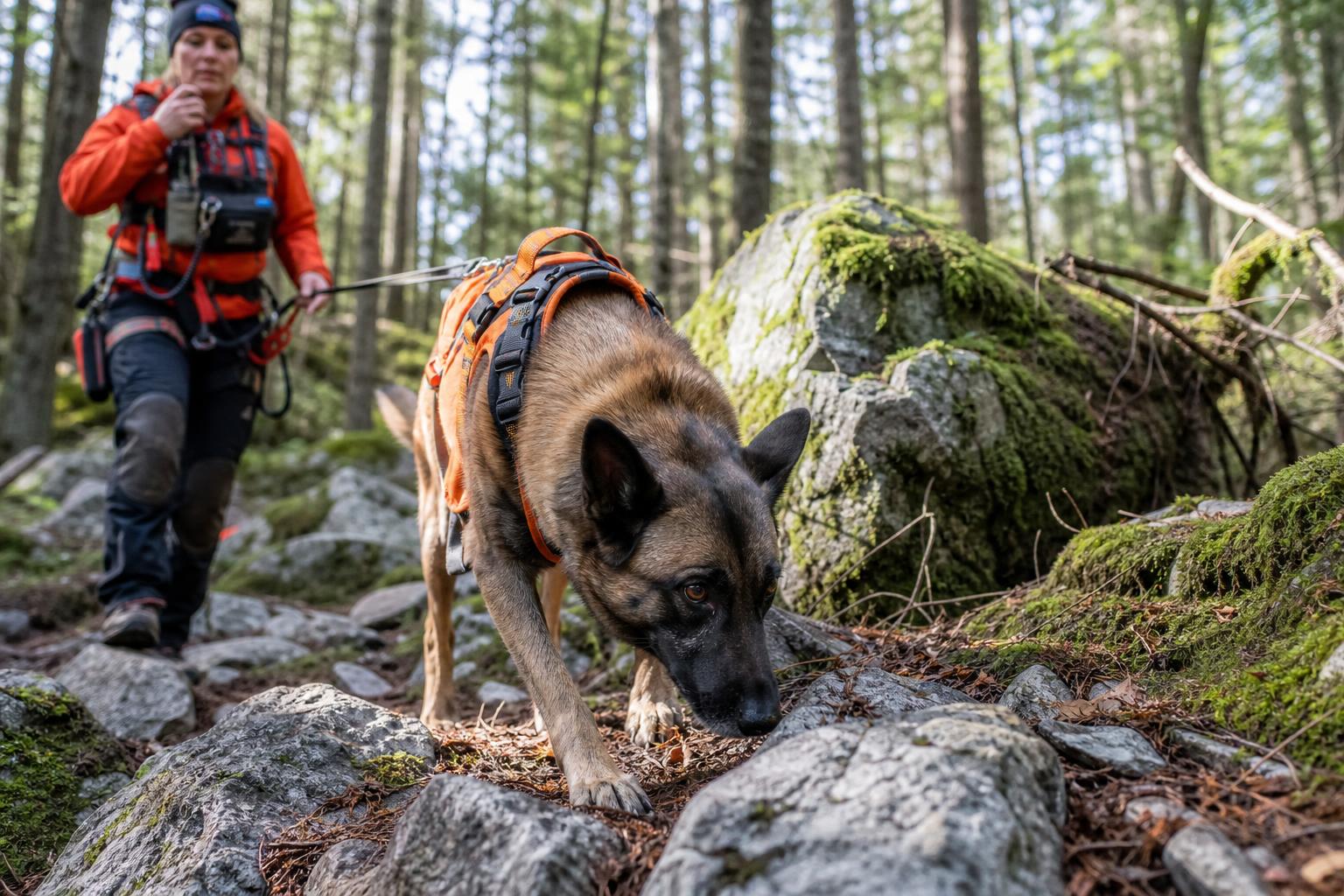
Search and rescue work is the craft of training a dog to help locate missing people and to work as part of a coordinated response effort. It can involve wilderness searches, urban disaster scenes, trailing and tracking, cadaver detection, and specialized environments like avalanches or water shorelines. What unites all of these is a simple reality: time matters. A dog can cover terrain and process scent information in ways humans cannot, and a well-trained team can dramatically improve the chances of a successful outcome. But it is not just about a dog finding someone. It is about a reliable operational team—dog and handler—integrated into safety protocols, communication systems, and mission planning.
Training builds both search skill and emotional durability. Dogs learn to hunt for human scent and to persist through complex scent pictures shaped by wind, terrain, and time. They learn how to work odor cones, how to re-acquire scent after a loss, and how to indicate a find clearly and confidently. Indications vary by type of work: a bark alert, a recall-refind, a bringsel, a sit at source. The best teams choose an indication that fits the environment and supports safe, unambiguous communication. Dogs also train for independence. In many search types, the dog must range away from the handler to be effective, then return with information. That independence has to be paired with control—recalls, directional cues when appropriate, and the ability to pause or disengage for safety.
Handlers have as much to learn as dogs. They study scent theory, terrain, navigation, weather, and search strategy. They learn how to read canine body language—subtle changes that signal odor, stress, or confusion. They learn radio protocols and how to work within incident command structures. They learn medical basics and safety: heat injury prevention, hypothermia risk, hazard awareness, and how to protect the dog’s body over long deployments. Training also includes “no find” scenarios so teams avoid false confidence. A dog that has only ever won in training can start inventing alerts under operational pressure. Honest training includes blanks, long searches with no target, and reinforcement plans that keep the dog motivated without rewarding incorrect indications.
At its best, search and rescue work is quiet competence under stress. The dog is focused, methodical, and confident. The handler is calm, observant, and safety-oriented. When the dog finds scent, the change is unmistakable: behavior tightens, pattern shifts, intensity rises, and then the trained alert behavior appears. That moment can be lifesaving. It is also the result of hundreds of hours of training, conditioning, and proofing in harsh environments. SAR teams tend to be humble about this, because they know the work is never “finished.” Dogs age. Conditions vary. Skills must be maintained. But for the teams who commit to it, SAR is one of the most meaningful ways a dog can contribute—turning instinct and training into real help when someone is missing and every minute counts.