
Hungarian hound
Basics
The Hungarian Hound—better known internationally as the Transylvanian Hound (Erdélyi kopó)—is an old Hungarian scent hound developed for hunting in varied terrain. Historically it worked big game in forests and open country, and the breed was later revived after a steep decline in the 20th century.
It’s a medium-sized, athletic hound built for stamina and distance rather than speed bursts. As a working dog it is expected to trail, give voice on a fresh track, and hunt with enough independence to keep working at a distance from its handler.
Description
The Hungarian Hound, also known as the Magyar Agar, is a versatile and skilled sighthound breed from Hungary, primarily bred for hunting. This ancient breed has a long history dating back over a thousand years, with roots believed to trace back to the steppe regions of Asia. The Magyar Agar was used for hunting small and medium-sized game, including hares, rabbits, and foxes, in the wide-open landscapes of Hungary. It is a dog that relies on its exceptional speed, agility, and sharp vision to chase and capture prey. The breed has been highly valued by Hungarian hunters for its stamina and ability to work in both solitary and group hunting situations.
Physically, the Hungarian Hound is a medium-sized dog with a slender yet muscular build, reflecting its purpose as a swift and efficient hunter. It typically stands between 24 to 28 inches at the shoulder and has a sleek, well-proportioned frame that supports its natural speed and endurance. The breed’s head is long and narrow, with a gentle, intelligent expression. Its coat is short and smooth, providing minimal resistance while running and allowing the dog to maintain its high-speed pursuits. The coat can come in a variety of colors, including fawn, brindle, and black, often with white markings on the chest, legs, or face. The Magyar Agar’s long, powerful legs and graceful, curved tail contribute to its elegant, athletic appearance.
The Hungarian Hound is renowned for its ability to run at high speeds for long distances. Like many sighthounds, it has exceptional vision that allows it to spot prey from far away, making it a formidable hunter. Its prey drive is strong, and it is driven by its instinct to chase moving objects. However, despite its independent nature while hunting, the Magyar Agar is also known for being affectionate and loyal to its family. It typically forms strong bonds with its owners and enjoys being part of the household. Although the breed is known for being calm and laid-back at home, it still requires regular exercise to keep its hunting instincts sharp and to stay in top physical condition.
In terms of temperament, the Hungarian Hound is typically gentle, calm, and independent, with a strong, natural hunting instinct. While it can be reserved around strangers, it is generally good-natured and social with its family, including children. However, due to its strong prey drive, it may not be suitable for households with smaller pets such as rabbits or cats unless properly socialized from a young age. As with many sighthound breeds, the Magyar Agar benefits from a home with access to open spaces where it can safely run and stretch its legs, but it also enjoys lounging indoors and is relatively low-maintenance in terms of grooming.
In conclusion, the Hungarian Hound is a remarkable breed that combines speed, intelligence, and agility with a calm, affectionate nature. Its history as a skilled hunter, along with its natural athleticism, make it an ideal companion for active individuals and families with the space to allow the breed to run and play. Whether working in the field or lounging at home, the Magyar Agar is a loyal and graceful dog with a deep connection to its historical roots as a hunting partner.
History
The Hungarian Hound, more commonly known as the *Transylvanian Hound* (*Erdélyi Kopó*), is an ancient scent hound breed that has a deep history in Hungary and the surrounding Carpathian Basin. Its origins trace back over a thousand years, to the time when the Magyars settled in the region during the 9th century. These early settlers brought hunting dogs with them, which were subsequently crossed with local breeds to develop the Transylvanian Hound. The breed was refined to excel in hunting in the dense forests and mountainous terrain of Transylvania, making it a highly valued companion for Hungarian nobility and hunters.
The breed was developed in two distinct varieties: a long-legged type for pursuing large game like boar, bear, and deer, and a short-legged type for hunting smaller game such as hare and fox. This adaptability, combined with its keen scenting ability and stamina, made the Transylvanian Hound a versatile and indispensable hunting dog for centuries. Its striking black-and-tan coat and athletic build further distinguished it as a breed well-suited to the rugged landscapes of its homeland.
The decline of the Transylvanian Hound began in the 19th and 20th centuries due to political changes, urbanization, and restrictions on hunting. By the mid-20th century, the breed was on the brink of extinction, with only a few individuals surviving in remote areas of Hungary and Romania. Efforts to preserve the breed were initiated in the 1960s, led by Hungarian enthusiasts who recognized its historical and cultural significance. Through careful breeding programs, the population was restored, and the breed was recognized by the Fédération Cynologique Internationale (FCI) in 1968.
Today, the Hungarian Hound remains a rare breed but is cherished for its intelligence, endurance, and loyalty. It continues to be used as a hunting dog in its native regions and has also gained recognition as a family companion for those who appreciate its active nature and rich history. The Transylvanian Hound stands as a living link to Hungary’s hunting traditions and the legacy of its early settlers.
Appearance
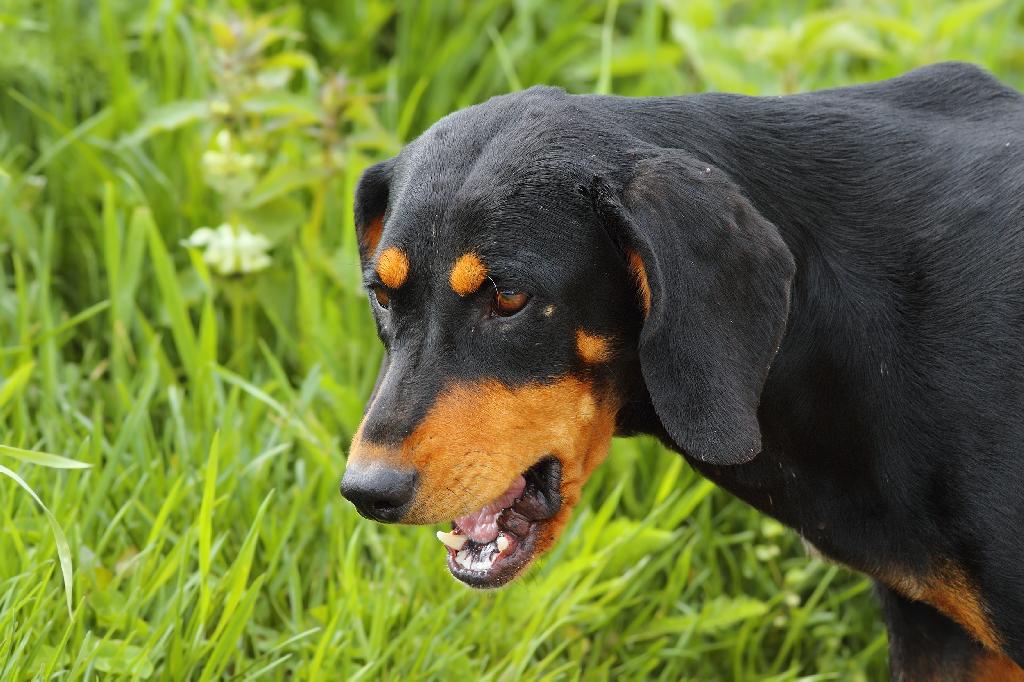
This is a clean-lined, strongly built hound with a slightly longer-than-tall outline and a deep, long ribcage that supports endurance. The head is long but not pointy, with a slight stop, dark almond-shaped eyes, and medium-length drop ears that lie close to the cheeks.
The coat is short, dense, and close-fitting, often described as coarse and glossy, with an undercoat for weather protection. Most dogs are black-based with clearly separated tan markings (including the characteristic “eyebrow” spots), and may have limited white on areas like the chest, feet, or tail tip.
The tail is set at a medium height and carried in a gentle curve when alert, not tightly curled over the back. Movement should look ground-covering and efficient—built for hours of steady work.
Colors
• Black & Tan
• Black Tan & White
• Red & White
Health
The Hungarian Hound is generally regarded as a tough, functional breed shaped by working selection, but like many medium-to-large athletic dogs it can still be affected by common orthopedic and general health issues. Keeping the dog lean and well-conditioned is one of the simplest ways to protect long-term soundness.
Because detailed, breed-specific health statistics are limited compared with more common breeds, smart ownership means choosing breeders who prioritize temperament, structure, and health screening (for example, orthopedic evaluations appropriate to their lines). Routine veterinary care, parasite prevention, and dental care remain the basics that matter most.
Also watch the practical “hound” concerns: ear health (especially after wet hunts or swims), small cuts to feet from rough ground, and safe exercise practices to avoid soft-tissue injuries. If your dog works hard in the field, discuss conditioning and recovery plans with your veterinarian.
Care
Coat care is usually straightforward: a quick weekly brush to remove dead hair, plus occasional baths as needed, is often enough. Pay extra attention to ears—drop ears can trap moisture and debris—so gentle, regular ear checks and cleaning can help prevent problems.
This is an athletic, working-type dog that thrives on daily exercise and purposeful activity. Long walks, hiking, and structured scent games (tracking, trailing, “find it”) fit the breed’s body and brain far better than short, repetitive play alone.
Nutrition should support a lean, muscular condition rather than rapid weight gain; extra pounds are especially hard on an active hound’s joints and stamina. For any dog expected to run and work, keep nails trimmed for traction and inspect pads after rough terrain.
Training
Train with the hound mindset in mind: motivation often comes from scent, movement, and food rewards more than repetition. Short sessions, clear criteria, and positive reinforcement tend to build reliability without creating avoidance or shutdown.
Recall is the big project for most scent hounds. Start with long-line practice, high-value reinforcement, and a strong emergency recall cue before granting freedom in unfenced areas—because once the dog is on a track, it may ignore normal cues.
Early focus on leash manners, calm greetings, cooperative handling (ears, feet, mouth), and settling skills pays off. If you want a hunting partner, seek a trainer who understands scent work and can channel drive into controlled searching and steady behavior around game.
Temperament
A well-bred Hungarian Hound is typically good-natured and brave, with a calm, even base temperament paired with determination when it has a job to do. Many are quiet in the house compared with some hounds, but “switch on” outdoors when they catch scent.
Because the breed was developed to hunt at distance, it can be independently minded and may appear reserved with strangers at first. With its people it should be steady and loyal, and it generally does best with clear routines and consistent handling.
As with most scent hounds, the nose can override everything—so impulse control and recall need to be trained deliberately. Good socialization and appropriate outlets for sniffing and tracking help the dog stay balanced and easier to live with.
Lifestyle
This breed fits best with people who enjoy being outdoors and can provide steady daily exercise. A bored Hungarian Hound may invent its own entertainment—following scent trails, roaming, or using its voice—so an active routine and enrichment are not optional.
They typically do well with a securely fenced yard or on-leash/long-line outings; off-leash reliability can be challenging around wildlife scents. Apartment living can work only if the dog’s exercise and scent outlets are met consistently, and if neighbors can tolerate occasional houndy vocals.
In the home, many settle nicely when their needs are met, but they are not “leave-it-and-forget-it” dogs. Expect to spend time on training, enrichment, and safe management of a powerful nose.
Ownership
Prospective owners should look for breeders who can explain working ability, temperament, and the breed standard—not just appearance. Ask about health screening, how puppies are raised and socialized, and what traits (drive, voice, independence) to expect as the dog matures.
Plan for management as much as training: secure fencing, a well-fitted harness/collar system, and a long line for safe freedom are practical essentials. If you live with other pets, early socialization and controlled introductions matter, since hunting breeds can have strong prey interest.
Because the Hungarian Hound is still relatively uncommon in many countries, patience is part of responsible ownership. Connect with breed clubs or hound/scent-work communities, and be prepared to travel for the right breeder or rescue match rather than settling for a poor-quality source.
Interesting Facts
- Also called the Transylvanian Hound (Transylvanian Scent Hound); Hungarian name: Erdélyi kopó.
- A Hungarian scent hound developed for hunting; historically there were long-legged and short-legged types.
- Medium-sized, athletic build with a short, dense coat; commonly black with distinct tan markings and limited white.
- Known for stamina and an independent working style; the nose can be powerful enough to challenge recall.
- Recognized by the United Kennel Club (UKC) and described in FCI-linked standards used by the Hungarian kennel club.