Leonberger
Basics
The Leonberger is a giant, lion-like working breed that originated in the 1800s in Leonberg, Germany. From the beginning it was bred to be an impressive-looking companion with the steadiness to live closely with people and the ability to serve as an all-purpose farm and family dog.
Well-bred Leonbergers are typically known for being devoted and people-oriented, often happiest when they’re included in daily life. Their size and strength, however, make them a better match for owners who want a big dog on purpose and can commit to training and management from day one.
Description
The Leonberger is a large, majestic breed of dog that was originally developed in Germany in the 19th century. Its creation is attributed to the efforts of breeders in the town of Leonberg, who sought to produce a dog that resembled the lion on the town's crest. The Leonberger is thought to be a cross between several breeds, including the Saint Bernard, Newfoundland, and the Great Pyrenees. This breed was initially used for a variety of purposes, including as a working dog for farms, as a draft animal, and even as a companion for the aristocracy. Today, the Leonberger is primarily known as a family companion, prized for its gentle nature and impressive size.
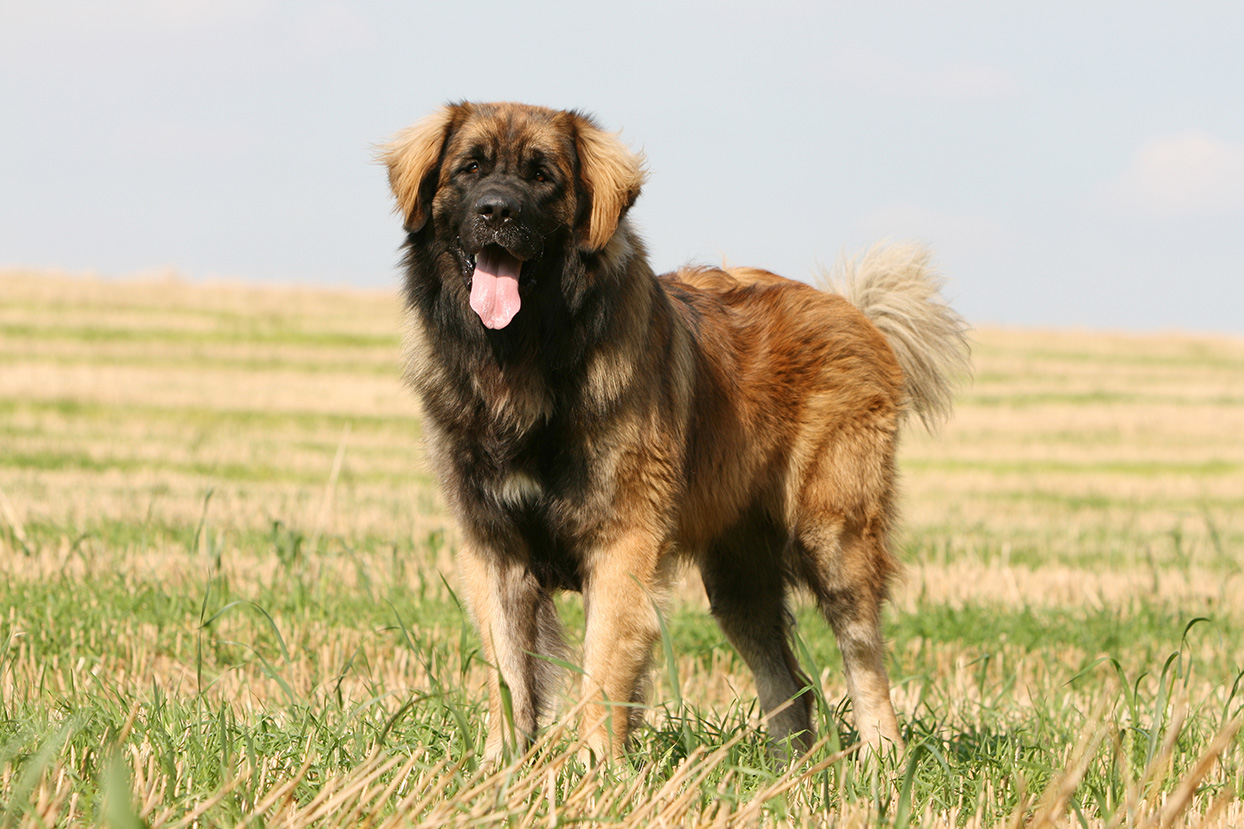
Physically, the Leonberger is an imposing yet graceful dog, standing between 25 to 32 inches at the shoulder, with males generally being larger than females. They can weigh between 90 to 170 pounds, making them one of the larger dog breeds. Their most striking feature is their thick, water-resistant double coat, which is typically a rich golden color, though it can also have shades of red and a black saddle marking on the back. The coat requires regular grooming due to its length and density, and while it makes the Leonberger look particularly lion-like, it also serves to protect the dog from the elements. With their large, powerful frame and long, flowing mane-like fur, Leonbergers possess a noble and dignified appearance.
Temperamentally, the Leonberger is known for being exceptionally gentle, friendly, and calm. They are often described as "gentle giants" due to their affectionate nature, particularly with children and other pets. Despite their large size, they are usually quite patient and tolerant, making them excellent family dogs. They are also very social and tend to enjoy being involved in family activities, often forming strong bonds with their human companions. While the Leonberger is generally calm, it is also an intelligent and trainable breed. They are eager to please, which makes training relatively easy, though they do benefit from early socialization and consistent, positive reinforcement training methods.
Due to their historical roles as working dogs, Leonbergers are also quite strong and enjoy having a "job" to do. They are often used as therapy dogs, search-and-rescue dogs, and in some cases, as water rescue dogs, thanks to their swimming ability and their natural instincts to help. While they do not have the high-energy demands of some working breeds, Leonbergers do require regular exercise to maintain their physical and mental health. Long walks, play sessions, and a good deal of social interaction are essential to keep this breed happy.
In summary, the Leonberger is a large, noble breed known for its gentle nature, intelligence, and versatility. Whether as a family companion, therapy dog, or working dog, the Leonberger thrives in environments where it can be an active and loved member of the family. With their impressive size, stunning coat, and affectionate temperament, Leonbergers continue to captivate dog lovers around the world.
History
The Leonberger is a majestic and gentle giant of a breed that originated in the mid-19th century in Leonberg, Germany. The breed was developed by Heinrich Essig, a prominent politician and dog enthusiast, who aimed to create a dog that would embody the grandeur of a lion, symbolizing the town’s coat of arms. Essig achieved this by crossing the Saint Bernard, Newfoundland, and Pyrenean Mountain Dog. His efforts resulted in a large, impressive dog with a luxurious coat and a kind, gentle temperament, which he marketed to European nobility and wealthy families as both a companion and working dog.
The Leonberger quickly gained popularity across Europe, becoming a favorite among aristocrats, including Empress Elisabeth of Austria and the Prince of Wales (later King Edward VII). While the breed’s appearance was a key factor in its appeal, its versatility was equally notable. Leonbergers were used for guarding estates, pulling carts, and even performing rescue work, thanks to their strength, intelligence, and willingness to work.
However, the breed faced significant challenges during the 20th century. Both World War I and World War II devastated the Leonberger population, as many dogs were lost or killed, and breeding efforts were severely disrupted. By the end of World War II, only a handful of Leonbergers remained, prompting a dedicated group of breeders to embark on a painstaking effort to save the breed. Their commitment ensured the Leonberger’s survival, and the breed gradually regained its numbers and popularity.
Today, the Leonberger is celebrated as a versatile and loyal companion. It excels in various roles, from search and rescue work to therapy and as a beloved family pet. Its imposing size is matched by its gentle and affectionate nature, making it a favorite among dog lovers worldwide. The Leonberger’s history reflects its resilience and the dedication of those who have worked to preserve this remarkable breed.
Appearance
Leonbergers are large, powerful dogs with a weather-resistant double coat and a balanced, athletic build. They are slightly longer than tall, with a strong head, drop ears, and a substantial tail, and they’re often described as having a “lion” look—especially when the mane is fully developed.
Coat texture is medium-soft to coarse, usually straight or slightly wavy, and many standards describe rich shades such as lion-yellow through reddish-brown with a distinct black mask. Because the breed is so heavily coated, the dog can look even larger than it measures.
Colors
• Red
• Reddish Brown
• Sandy
• Yellow
Health
Leonbergers, like many giant breeds, can be prone to hip and elbow dysplasia, bloat (GDV), and certain cancers. Breed health resources also track conditions such as congenital cardiac disease, thyroid disease, and inherited neuromuscular issues like Leonberger polyneuropathy.
Owners can reduce risk by choosing breeders who follow health-testing and evidence-based breeding practices, keeping the dog lean, and learning emergency signs of bloat. Regular veterinary checkups matter in this breed because some serious problems (joint disease, cardiac issues, neurologic weakness) are easier to manage when caught early.
Care
Coat care is a real part of Leonberger ownership. Weekly brushing helps prevent mats, keeps the undercoat from packing down, and reduces shedding around the home; during seasonal blowouts, grooming time increases. Expect hair in the house and plan on a sturdy vacuum.
Because they’re giant dogs, routine care also includes regular nail trims, ear checks, and close attention to skin hot spots that can develop under a dense coat. Many Leonbergers also enjoy water, so owners should be ready for a dog that may come home wet (and heavy) and needs thorough drying.
Training
Training should start early and focus on everyday safety skills: loose-leash walking, calm greetings, a reliable “leave it,” and settling on a mat. Leonberger puppies grow fast, so it’s much easier to build good habits before the dog is 120+ pounds.
Group classes and structured socialization are especially valuable—learning to work with the handler around distractions and meeting many people and environments while young helps develop the breed’s desired self-confidence. Keep sessions upbeat and consistent, with clear rules the whole household follows.
Temperament
A good Leonberger is typically confident, friendly, and dependable with family and familiar visitors. Many are especially gentle with children, though their sheer mass means manners and supervision matter—an enthusiastic greeting can easily knock someone over.
They’re often clever and eager to participate, but they still need guidance as adolescents. Without training and social exposure, a young Leo’s size can turn normal puppy behavior (jumping, pulling, mouthing) into a real handling problem.
Lifestyle
Leonbergers tend to do best in homes that have room for a giant dog to move and sprawl without constantly being underfoot. They’re usually happiest when they can be close to their people (not left outdoors alone), with daily exercise and a calm routine.
They can be wonderful “do-everything” companions—hikes, family time, training classes, and often water activities—but they aren’t low-maintenance. A bored or under-exercised young Leo can become rowdy, destructive, or overprotective simply because it has too much dog and not enough structure.
Ownership
Bringing home a Leonberger is a commitment to a giant-breed lifestyle: training, grooming, and realistic planning for space, food costs, and transport. A well-trained adult Leo can be calm and affectionate, but the puppy and teenage stages require patience and a plan.
Prospective owners should prioritize reputable breeders, meet adult dogs if possible, and be honest about whether their home can handle shedding, mud/water, and a dog that can cross a room quickly. If the answers are yes, the reward is often a deeply connected family companion with real working-dog capability.
Interesting Facts
- Origin: Leonberg, Germany; the breed was developed in the mid-1800s.
- Look: large, lion-like dog with a double coat; many standards describe a black mask.
- Temperament: loyal, family-oriented, often very fond of children when well bred and trained.
- Water: many Leonbergers are notably enthusiastic swimmers and water dogs.
- Health focus: giant-breed risks (hip/elbow dysplasia, bloat) plus breed-specific concerns such as polyneuropathy.
- Practical reality: heavy shedding and fast puppy growth make early training and regular grooming non-negotiable.