
Russian Black Terrier
Basics
The Black Russian Terrier is a large, powerful working dog developed in the Soviet Union for military and police-style roles. The breed was designed to be versatile—capable of guarding, handling harsh weather, and working closely with a handler.
Today, well-bred Black Russian Terriers are often devoted family companions with serious protective instincts. They’re intelligent and confident, but they’re not a casual “easy first dog”—they need structure, training, and consistent leadership.
Description
The Russian Black Terrier is a large, powerful, and versatile breed that was originally developed by the Soviet Union in the mid-20th century. This breed was created to be a working dog capable of handling a variety of tasks, particularly in harsh environments. The Russian Black Terrier is a mix of several breeds, including the Rottweiler, Airedale Terrier, and Giant Schnauzer, among others. Its primary purpose was to serve as a guard dog for military and police forces, and it quickly earned a reputation for its protective instincts, strength, and intelligence. Over time, the breed has also found a place as a family companion, especially in active households that appreciate its loyalty and versatility.
Physically, the Russian Black Terrier is a large and robust breed, with males typically standing between 27 and 30 inches tall at the shoulder and weighing between 80 and 130 pounds. The breed’s imposing appearance is characterized by its dense, wiry black coat, which serves as protection in both cold and wet conditions. Its strong, muscular frame gives the Russian Black Terrier an imposing presence, but it is also agile and highly capable in a variety of environments, whether in the home or on the job. The breed's thick coat requires regular grooming to prevent matting and maintain its distinctive appearance, though it is relatively low-shedding, making it a good choice for people with allergies.
Temperamentally, the Russian Black Terrier is known for its calm, confident, and protective nature. It is typically reserved and aloof with strangers, making it an excellent guard dog and watchdog. However, it is also highly loyal and affectionate with its family, forming strong bonds with its owners and being particularly protective of children. While the breed is generally good-natured, its natural instincts to guard and protect can make it cautious around unfamiliar people and situations. Early socialization and consistent training are crucial to ensure that the Russian Black Terrier grows into a well-mannered and balanced dog. The breed’s intelligence and eagerness to please make it highly trainable, though its independent nature means it requires an experienced owner who can provide firm, consistent leadership.
The Russian Black Terrier is an active breed that requires plenty of physical and mental stimulation to remain happy and healthy. It enjoys regular exercise, such as daily walks, runs, and play sessions, and excels in dog sports such as obedience, agility, and protection work. Despite its working dog heritage, the breed can adapt well to family life, provided it receives adequate exercise and mental challenges. The Russian Black Terrier thrives in environments where it can be an active part of the family, but it also needs clear boundaries and structure to avoid becoming overly protective or territorial. With the right training, care, and socialization, the Russian Black Terrier makes a devoted, protective, and loyal companion that excels in a variety of roles, from guarding and protection to family companionship.
History
The Russian Black Terrier, often referred to as the "Black Pearl of Russia," is a robust and intelligent working dog developed in the mid-20th century by Soviet breeders. Its creation was driven by a military need for a versatile and durable service dog that could perform a range of tasks, from guarding to search and rescue, in diverse and challenging conditions. The breed’s development began in the late 1940s at the Red Star Kennel, a state-operated facility tasked with creating working dogs for the Soviet armed forces.
The Russian Black Terrier was developed by crossing several breeds known for their strength, intelligence, and working abilities. These included the Giant Schnauzer, Rottweiler, Airedale Terrier, and Newfoundland, among others. Breeders aimed to combine the best traits of these breeds, resulting in a large, powerful dog with a thick, weather-resistant coat and a balanced temperament. The breed was designed to handle the harsh Russian climate and excel in guarding and military roles.
By the 1950s, the Russian Black Terrier was being deployed as a guard dog for military installations, prisons, and other high-security facilities. Its versatility, trainability, and imposing presence made it an ideal choice for these roles. Over time, the breed began to gain recognition outside of military and working circles. In 1957, the first Russian Black Terriers were shown at a dog exhibition in Moscow, marking the beginning of its journey as a recognized breed.
The breed gained international recognition in 1984 when the Fédération Cynologique Internationale (FCI) officially acknowledged the Russian Black Terrier. It was later recognized by the American Kennel Club (AKC) in 2004. Today, the Russian Black Terrier is celebrated not only as a working dog but also as a loyal and protective family companion. Its history as a purpose-bred military dog reflects its strength, intelligence, and adaptability, making it a favorite among enthusiasts worldwide.
Appearance
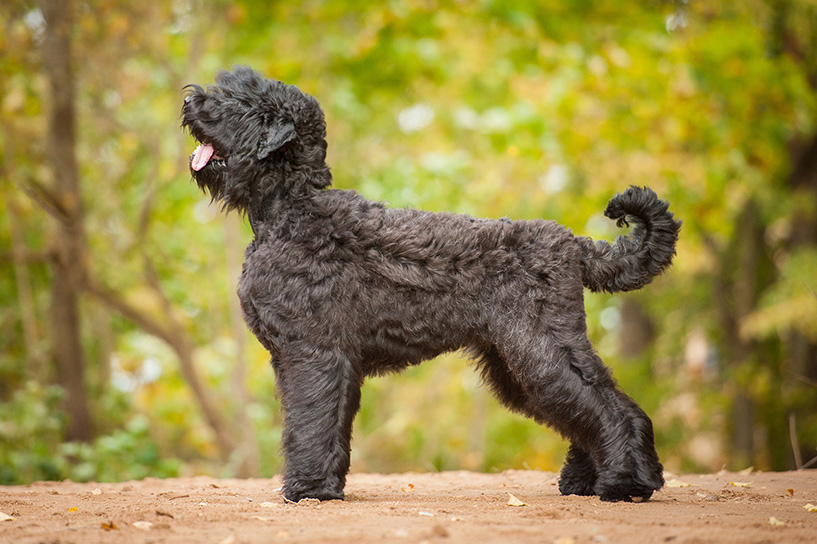
Black Russian Terriers are tall, heavy-boned dogs with substantial muscle and an unmistakable all-black coat. The coat is dense and coarse, typically with facial furnishings—beard and pronounced eyebrows—that give the breed its signature expression.
They have drop ears and a strong, athletic frame under the coat. The overall look should be powerful and balanced rather than bulky, with a working-dog presence.
Colors
• Black
• Black & Tan
• Blue
• Sable
• Salt & Pepper
Health
Like many large breeds, Black Russian Terriers can be prone to orthopedic problems such as hip and elbow dysplasia. Eye disease is also a concern in the breed, and responsible breeders screen for issues such as progressive retinal atrophy.
Choose breeders who provide documented health clearances (for hips/elbows and eyes) and who can discuss the health history of their lines. Keep your dog lean and fit to reduce joint stress, and maintain routine veterinary care throughout adulthood.
Care
Their coat looks rugged, but it requires ongoing maintenance. Expect regular brushing/comb-out to prevent matting and to keep the skin healthy, plus professional trimming on a schedule that matches your preferred length and look.
Daily care also includes exercise and mental work: brisk walks, training, and problem-solving games help keep them balanced. Because of their size and strength, prioritize safe handling skills (leash manners, calm greetings) as part of “care,” not just “training.”
Training
Start early and be consistent. Black Russian Terriers are smart, capable problem-solvers and usually do best with firm, fair, reward-based training that emphasizes engagement and impulse control.
Socialization is not optional: introduce the puppy to many people, places, and situations in a positive way, and keep practicing through adolescence. This breed can excel beyond basics—obedience, tracking, agility, and other working activities can be great outlets.
Temperament
Courageous, confident, and very people-focused, this breed tends to be deeply loyal to its household. Many are naturally aloof with strangers, which is normal for a dog bred to guard and protect.
That protective streak needs guidance. Early socialization, clear household rules, and calm handling help prevent over-guarding, reactivity, or territorial behavior—especially as the dog matures into its full size and confidence.
Lifestyle
This breed fits best with owners who want a steady guardian-type dog that lives as part of the household. They typically don’t thrive with minimal interaction or inconsistent routines; they want a role and a relationship.
A fenced yard is helpful but not a substitute for engagement. Expect a dog that is calm at home when exercised, watchful around the property, and happiest when included in the family’s daily life.
Ownership
Owning a Black Russian Terrier means committing to training, socialization, and grooming—plus managing a large dog with real protective instincts. The “easy years” are earned by doing the work early and continuing it as the dog matures.
If you want an impressive, devoted companion and you’re comfortable being consistent and proactive, the breed can be deeply rewarding. If you want a universally social dog with minimal maintenance, this is likely the wrong match.
Interesting Facts
- Developed in the Soviet Union starting in the 1930s for military/police-style work.
- Created using multiple breeds (often cited: Rottweiler, Giant Schnauzer, Newfoundland, and Airedale Terrier among others).
- Coat: dense, coarse, and black, with a characteristic beard and eyebrows.
- Temperament: devoted to family, typically aloof with strangers.
- Common concerns: coat maintenance, early socialization, and joint/eye health screening.